Sunday, October 23, 2016

Processing the Olives

We have a lot of olives trees on the property of the Jerusalem Center so traditionally when the olives are ripe in the fall, they are picked by the students and pressed for the oil. Olives are harvested only in October so we were excited to experience the process. There are two ways to pick the olives: boughs of the tree are shaken and the olives fall into a sheet set on the ground or they are dropped into a plastic bag so they don't touch the ground. The olives were quite scarce this year so it was much harder to find enough to process.


One week ago, the students picked all of the olives and last Wednesday they were pressed the old fashioned way! The olive is meaningful to the Jews and symbolizes light. It still feels like summer here so it's hard to imagine that our grandchildren are preparing for Halloween back in the US and our desert tortoise has gone into hibernation.


Photo: Olive trees. There are 7 species of olives in Israel. Olive trees can easily resist drought, diseases and even fire and their roots regenerate the trees even after the ground is destroyed. Therefore, they live many years and the older they get, the more interesting they are as the trunks become thicker, twisted with so much character. We have some olives trees in our yard in Arizona and even though they are 35 years old, the trunks are not gnarled like ones we have here.


Photo: Garth picking olives.


Even more significant than the olives are the leaves because they are the symbol of peace. The olive and the leaf also symbolize the link between the young state of Israel and its ancient two thousand year old history in which the olive tree and its oil played a very significant role.
The dove brought Noah an olive leaf after the flood to show that the waters had subsided. Since then, olive leaves have symbolized the hope that peace takes the place of all the evil and destruction of the world. Genesis 8:11 And the dove came unto him at eventide; and lo in her mouth an olive-leaf freshly plucked; so Noah knew that the waters were abated from off the earth.


Photo: Olives. The students were determined to pick enough olives to fill a huge container in preparation for pressing the following week.
 

The State of Israel chose the olive leaves around the Menorah as its emblem and Olive Street is the most popular name for streets in Israel.


Photo: Even the little people who live here participated. This is one of the professor's children and our students love to interact with them.


Photo: The big, limestone wheel will crush the olives when it is moved round and round.


Photo: This is the oldest olive tree on the premises and is estimated to be 600 - 800 years old. The tree was dead but because the roots were still alive, it came back to life after two years. Now the tree is huge. Some olive trees have been known to live for more than 2,000 years. The Bible says the Garden of Gethsemane was where Jesus was betrayed by Judas and in that garden are some very old trees. I have always loved visiting the Garden which is a short distance from the Jerusalem Center.


Photo: Olive trees in the Garden of Gethsemane. These trees are estimated to be anywhere from 1,600 to 1,800 years old. When we first visited Israel in 1971, visiting this garden was one of my favorite places.


Up to twenty gallons of oil can be derived from the olives of one tree and it can live and bears fruit for centuries. Old olive trees usually have young shoots springing up all around it from its roots.


Photo: This is one of two olive mashers. The olive tree becomes fruitful when it is about six years old and the older it gets, the more fruitful it becomes. There are many varieties of cultivated olives, some being suitable for oil, and some for food as preserved olives. Its foliage is dense and when it becomes old, the fairly tall trunk acquires a unique pattern of twists on its bark. There are trees in Israel estimated to be 1,000 years old that still produce fruit. In old age, the tree becomes hollow and the trunk continues to grow thicker.


Photo: The olives are rinsed and then buckets of olives are put into the trough where the limestone wheel will crush them.


The olives are smashed until they look like guacamole. As you can see, this takes some manual labor!


When the olives are smashed, they are put into a woven doughnut holder and taken to the olive press.
  This is one of the olive presses. The doughnuts are stacked up and when pressed, the oil begins to leak out.


Photo: I've become addicted to green olives while living here. Because I crave them, I always keep a container in my fridge to snack on. Thinking about them makes me one so I'll be right back!

Photo: Fresh olives are sold everywhere so I am continually tempted to buy more. This photo was taken at one of the markets. Notice the MANY varieties? I used to love black olives but now the green ones are my favorite.
Pressing the juice from the olives. Olive trees are among the oldest broad-leaved trees in the world.
The juice begins to run out and flows into a basin and then and into a cylinder type vessel full of water.
The juice/oil flows into the pots and then the oil will float to the top. At that time, it will be extracted, strained, and then strained again. The first press is the extra virgin oil.

Dr. Roy Huff, Associate Academic Director, and Ella. We love working with Dr. Huff. He is always involved in with the students in all of their activities.

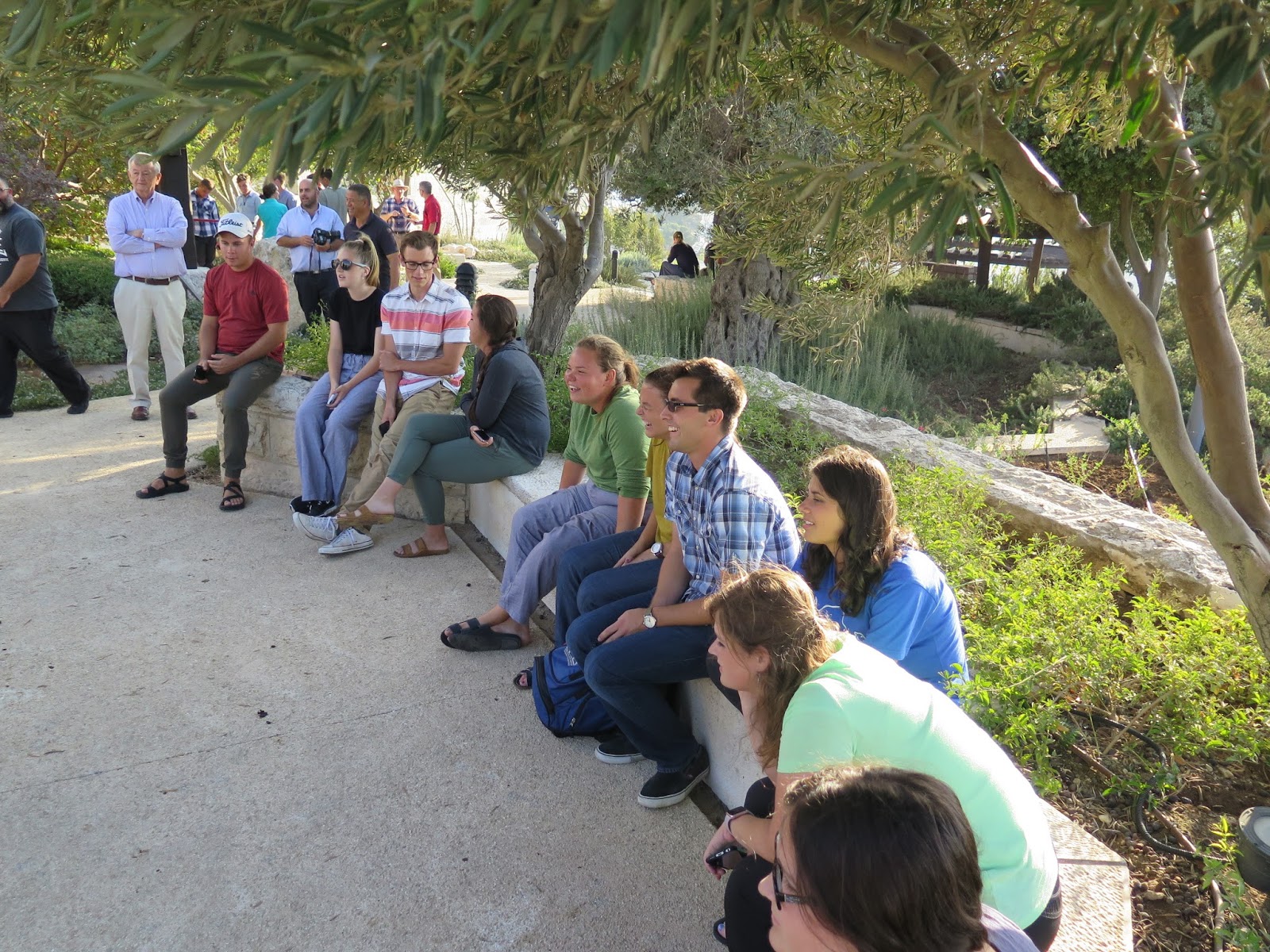
Photo: The young man in the red shirt at the left is Jarom and vice-president of the choir. He's an extremely talented tenor and we learned this his grandmother was raised in Burley, Idaho, with Garth. And . . . when Garth was 4 or 5 years of age, he and his grandmother (Nadine Baer) were married in Garth's front yard. Small world! Ali and Kylan are musically talented and also in the choir.
This is another type of olive press that uses stones weights.


Photo: Of course, Nassif, our IT director, was there with his new toy, a drone, and was documenting our activity from above. Whenever there is a toy, there is always a boy somewhere close by.
Photo: A couple of heavy weights.
Photo below: The oil is just beginning to drain into the cylinder of water of the 2nd press.
Photo: A little more oil has drained into the cylinder.
Photo: Kelsie and Brooke (sisters) are students at the JC. Both are extremely talented singers.
Photo: Geoffrey is the grandson of the late Paul Brenchly, a dentist from our stake. We were thrilled to meet him. He is president of the choir and the first time we met him he said, "Holyoak is not a common name. I think you might have known my grandparents in your stake in Scottsdale" and he was right. Having such gifted students like Geoffrey makes my job easier.
Photo: We love the students!
We were hoping to watch when workers extracted the oil from the pots but they needed to drain over night. When I went out the next day, the workers had already cleaned up the mess and skimmed the oil from the water pots. Many places that we have visited on field trips have had olive mashers.
Another was way of making oil, as mentioned in the Bible, was to tread the olive berries with the feet. This primitive method was mentioned by the prophet, Micah: "Thou shalt tread the olives, but thou shalt not anoint thee with oil" (Micah 6:15).
Olive oil was considered to be one of the most important staples. The widow who fed Elijah said to him: "I have not a cake, but an handful of meal in a barrel, and a little oil in a cruse." (I Kings 17:12). Olive oil was also considered to be one of the great sources of wealth in the days of King Solomon. Now that you have learned something about olives and their processing, I hope you can appreciate the work involved. Mynext entry will focus on Sukkot, a very interesting Jewish custom and holiday.

Monday, October 17, 2016

Mount Herzl Park

Recently we had the opportunity to visit Mount Herzl Park which is named after Binyamin Se'ev (Theodore) Herzl, visionary of the Jewish State.


This site has a national importance for Israel and the Jewish people. Important festivities take place which mark the conclusion of Memorial Day (May 12, 2016) for Israel's fallen soldiers and Israel's Independence Day.


Mount Herzl is also the resting place of great leaders of Israel such as their presidents, prime ministers and other dignitaries.


Ophir, one of our professors, was our tour guide for the park. Photo below: A huge menorah stands at the entrance of the park and is lighted for special holidays.


When the park was first established in 1952, these trees were donated by visiting dignitaries. Photo: Soldiers at Herzl's tomb.


Herzl's tomb lies on the crest of the mountain range overlooking the Judean Hills on one side and both old and new Jerusalem on the other. It is customary for visitors to place a rock on tombstones when they visit. The tombstone is constructed of black marble with only the four Hebrew letters of Herzl's name engraved on it.


Benyamin Ze'ev (Theodore) Herzl was born in 1860 and in 1896 he published his book, The Jewish State, in which he presented his vision for the establishment of an independent state for Jewish people. He died at age 44 and was originally buried in Vienna. In his will, he requested to be buried along with members of his family in Israel following the establishment of a Jewish state. In 1949, his wishes were honored when his coffin was laid to rest in a special ceremony on Mount Herzl.


Photo:Benny, one of my students from the choir. He has an amazing tenor voice and a charming personality. The section of the park was for national leaders. The tombs are black or grey marble and uniform in shape.

Photo: Grave of former Prime Minister, Golda Meir.

Shimon Peres was the ninth President of Israel, serving from 2007 to 2014. Peres's political career spanned nearly 70 years as he served twice as the Prime Minister of Israel and twice as Interim Prime Minister and was a member of twelve cabinets. He died Sept. 28, 2016, at the age of 93 after suffering a stroke in Tel Aviv.

Peres was highly respected and even though he spoke Polish, French, English, Russian, Yiddish and Hebrew, he never lost his Polish accent. He was a poet and songwriter and some of his poems were recorded as songs in albums. He was brilliant and often quoted French literature, Chinese philosophy, and Hebrew prophets.

Photo: We visited Mount Herzl the week following Peres's interment and these were wreaths that had just been taken off his grave site.


Photo: Grave of Perez, former Israeli Prime Minister and President of Israel. President Obama said in a White House Statement, "There are few people who we share this world with who change the course of human history, not just through their role in human events, but because they expand our moral imagination and force us to expect more of ourselves. My friend Shimon was one of those people." President Obama also flew to Jerusalem to attend his funeral.

Photo: While we were standing at his grave, a young Jewish soldier came to pay tribute. She knelt down, paused for a few moments and thoughtfully placed a stone on his grave.

We somberly stood and watched and felt grateful to have also had the honor of placing our own stones on his grave. (I was bent down at the grave with my camera when the soldier came to pay respect and able to snap some shots discretely.)

Photo: Ribbons from each department of the government were draped over the grave. Visitors signed names on the rocks that they left. I love this tradition!


We stepped aside to allow this soldier to have a few moments to pay respect before we took our own photos. We wanted a photo so we could say we were there.


Photo: It was a privilege to see the grave of Peres but smiling for the photo seemed awkard as we were also there to pay respect. Some of our JC students also attended his viewing in Jerusalem prior his funeral.


Photo below: Fallen soldiers.
Memorial Day was May 10, 2016, and the day where people in Israel pay respect to fallen soldiers and victims of terrorism.
Sirens could be heard throughout the city the night before and the country came to a standstill at 8 PM. People stopped their cars and stood silently for a minute or two in honor of those who died. It is the most somber of all the dates on the Israeli calendar. Radio and TV stations stop their local programming and documentaries are aired. Restaurants and places of entertainment also shut down. This past year, 28 Israelis and two Americans were killed but Israel also reported that about 200 Palestinians were killed in clashes with Israeli forces.


Photo: Looking across from cemetery to the Holocaust Museum.