Tuesday, January 24, 2017

Auguste Victoria (Church of the Ascension)

Last week we accompanied the students on a field trip to see views of the city from various lookout points.  We stopped at the Auguste Victoria tower which is situated at the top of the Mount of Olives, just a short distance from where we live. 


The photo above shows the tower of the Auguste Victoria (Church of the Ascension) at night. Note how the tower soars upward on the Mount of Olives, located just above the Seven Arches Hotel and the Jewish cemetery below.


All 83 students, two professors, along with Garth and I  were 
anxious for another day to explore.  


Dr. Esplin explained that the Augusta Victoria Bell tower sits at the highest point on the Mount of Olives, 2,670 feet above sea level and that we would be walking to the top for an even better view a little later. 


The Augusta Victoria Tower is the tower of the Church of the Ascension, a German Protestant Church, which rises 140 feet upward. It was built to this height in the 1870's so that pilgrims unable to walk to the  Jordan River could climb its 214 steps and at least see the spectacular panoramic view and the river. 

The bell tower bells ring only in pitches D, E, G and B with the largest of them weighing 6 tons. The bell was cast in Russia but was pulled mainly by Pilgrim women on a circular wagon from the port of Jaffa. In order to transport the bells from Jaffa (Israel) to Jerusalem, the road had to be widened and paved. Even though the the distance was only 55 miles, the cost was more than double it was to transport the bells from Germany to Israel!  We were told that these were the first Christian bells to ring in the Ottoman city of Jerusalem.  


Interestingly enough, the bells harmonize with the those of Dormition Abbey, the Basilica  of the Holy Cross and the Church of the Redeemer in the Old City.  The complex was built beginning in 1907 by Empress Augusta Victoria for the German Protestant community in Palestine but is now run by the Lutheran church.
Dormition Abbey

Basilica of the Holy Cross

Looking up at the steeple of the Church of the Redeemer 
from the rooftop of the Holy Sepulchre.
Photo below:  Auguste Victoria Compound. 
Ariel view of the Auguste Victoria Compound includes a hospital, a hostel and more.
Throughout much of the history of Auguste Victoria, the compound was used mostly as a military hospital or headquarters during the 1st and 2nd World Wars and for Palestinian refugees.  In the 1930's , it was used by the Nazi party and at that time a hostel was opened.  At the beginning of World War II, the building was used as a hospital by the British and prior to the Six-Day War (1967), it was fortified with bunkers.  During the Six-Day War, it was damaged and the upper floor was destroyed by fire.  In 1988, the artwork was restored to its original condition and is now currently run by the Lutheran Church. In 2007, the 100th anniversary was celebrated.  

Today the 161 bed hospital is an oncology clinic for ear, nose and throat diseases.  This is in cooperation with the United Nations Relief and Works Agency and treats mostly Palestinians and refugees.


This is the entry to the church.


This ornamental sculpture of King David and his harp adorned a wall in the entry.


When we entered the church, we were thrilled to see beautifully detailed ceiling pantings, mosaics in the apse of the choir and in the gallery.   We had to time a few moments to absorb the beautiful artwork and the amazing architecture.  The center of the ceiling painting depicts Christ after His resurrection with apostles, Peter and either James or John on each side.  (Did you know that James and John were brothers?) 


The Church was built in Byzantine style.   The light filtered in 
through gold colored glass  windows.

Drs. Ludlow and Esplin lead separate groups of students and after a little time to sing, 
(the acoustics were wonderful) we were allowed to walk around and explore. 


The Byzantine floors were really beautiful!


While the church is dedicated to the Ascension of Jesus, 
it also claims a connection to John the Baptist.  


As I looked up,  I saw organ pipes upstairs so I slipped off to find the organ console.


I went upstairs and was fascinated by the gorgeous mosaics along the arches but then I saw some large pedals connected to bellows used to pump air into the organ pipes.  I couldn't resist trying them out. This very old pump organ was built in 1910 by the Sauer Company from Frankfurt, Germany. 

I looked up for a closer view of the pipes.  I should have counted them.  
Our organ at the Jerusalem Center has 3,165!


I was delighted to find this organ console but it was locked!  However, because Dr. Ludlow wanted me to play, he asked for permission and I was given a key to unlock it.  Whee . . . how fun for me!  I keep saying this but every day I live in Israel, I learn something new.  This takes the cake today!


"Hey, I want to help," said Tommy.


I unlocked the doors and found a four octave console with two keyboards. 

The pedals were really worn and I wondered if it would even play. Aaron and little Tommy Esplin were determined to pump the air so the organ would sound.


They shouted out, "Start playing . . we are pumping!"


The next thing I know, I was pushing down some stops and the lovely flute tones were sounding.  I began playing a few hymns and the Irish tune, "Take Time to be Holy." I thoroughly enjoyed this experience.  Now I want to go back but this time take some music.  and take some music the next time.

At the end of the hallwas was this print of Jesus of Nazareth on a donkey.


There were some beautiful rooms on the upper level so I took a little more time to explore.


Directly across this room was another with the Crucifix.  


The arches were so beautiful I could have stayed much longer just to admire them.


This painting depicts the founding couple of this church, Emperor Wilhelm II and Empress Auguste Victoria, dressed in the style of the crusader period of the Middle Ages.


Below: This painting is called "Holy City of Jerusalem" of the Middle Ages.


The work of the local stone masons has earned much interest because 
of the richness of their form and the details of  workmanship.

A replica of The Ark of the Covenant.   Inside the Ark was manna, Aaron's rod, and Tablets of Stone (which are the Ten Commandments).


The ornamental motif tells the story of the last days of Christ's life.   
Mary holds her son, Jesus, after He was crucified.


Time was flying and it was time to leave but I needed one more look at the beautiful details.


The painting above depicts Christ's prophecy of the destruction of Jerusalem. Luke 21: 5


Notice the  Coat of Arms in the window.  Various Coat of Arms 
were displayed in all of the small arched windows.  
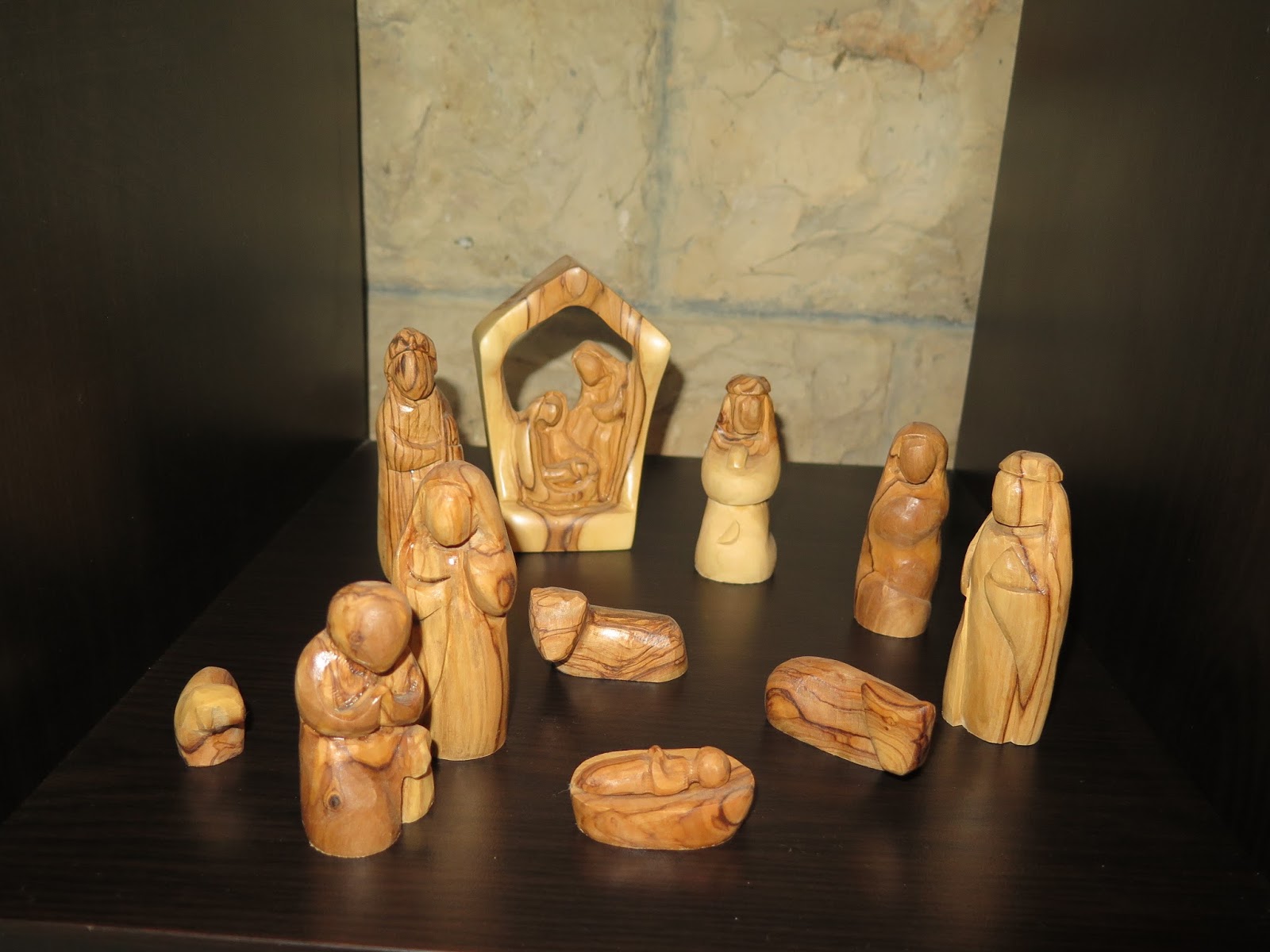

Just outside the church was a small gift shop where I saw a miniature creche.  
It was simplistic in design but lovely.  The figures were about 3-4" tall
 and baby Jesus was about 1" in length.   I immediately thought of
our grandchildren and knew they would love this.


I conclude this entry with a quote by Corita Kent: 
 Love the moment and the energy of that moment will spread beyond all boundaries. 


Friday, January 20, 2017

Notre Dame Hotel: The Shroud of Turin Exhibition

The other night we had the opportunity to attend an exhibit at the Notre Dame Hotel in Jerusalem.  We were surprised to see Christmas decorations still in place but I must say the lights added to the grandeur of one of our most favorite hotels in Jerusalem.  We have been to this hotel on several occasions for dinner but never realized there was any type of exhibition open to the public, let alone of the  Shroud of Christ! Therefore, a group of 14 from the Jerusalem Center slipped away from our responsibilities to see an exhibit we had never seen before.


At the entry of the exhibition, was the trunk of a very old olive tree. Olive wood carvings are very popular in Israel.  I'm not certain why it was on display  . . . perhaps for a close-up view of an old, gnarled olive tree trunk.  


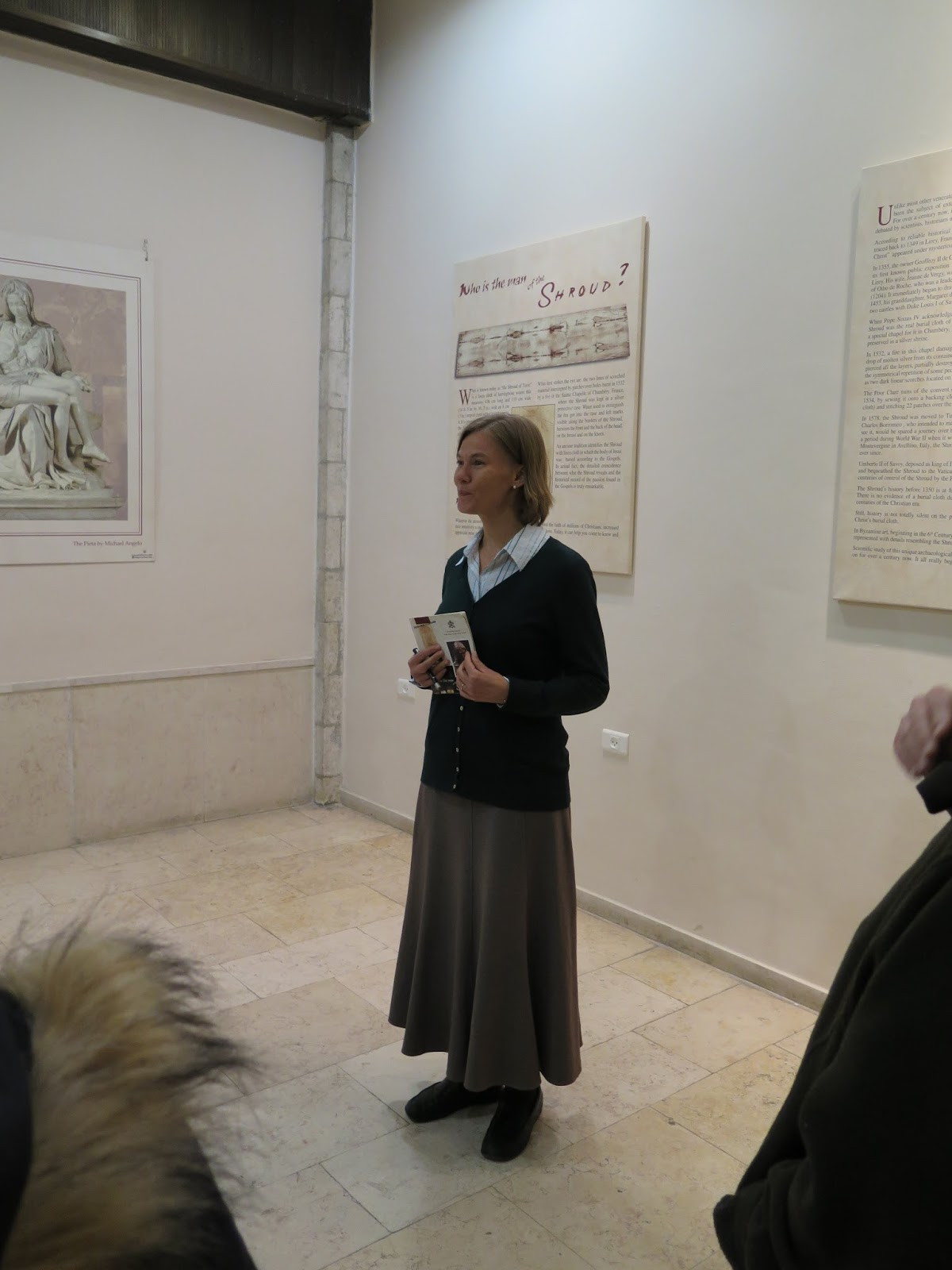
The Notre Dame Hotel functions under the auspices of the Catholic Church.  Our tour was conducted by a sweet nun (Sister Johanna Von Siemens) from Germany.  This was the first time any of us had heard about the Shroud of Christ exhibit in Jerusalem. We were all fascinated by what we saw and were eager to learn more.


When we walked in, we saw a print of Jesus hanging on the wall and I immediately felt right at home.   This is a print I've seen all my life in churches in America but never in Jerusalem. 


Next to the print of Jesus was a photo of the marble statue, the Pieta, which is on permanent display at St. Peter's Basilica in Rome, Italy.  There is an interesting story behind this sculpture.  


A French cardinal wanted to be remembered long after he died so he hired Michelangelo to make a memorial for his tomb of the Virgin Mary taking Jesus down from the cross. It is a beautiful life-size marble sculpture. However, proportionally, Mary is much bigger and if standing would be 7 feet tall. Nevertheless, it is an amazing sculpture. Garth and I saw this when were in Rome the summer of 1971 before it was damaged by a man who hit it with a hammer (1972). 


The Shroud of Turin has been the subject of extensive research for more than 100 years.  It has been scrutinized and examined over and over again by historians, scientists and theologians in the effort to test its authenticity.  

The Shroud is a linen cloth that bears the image of a crucified man.  It bears the marks of a man who bore a crown of thorns along with markings that parallel the wounds of Jesus of Nazareth when He was crucified.  It is the single most studied artifact in human history and now with DNA testing, we know more about it than we ever have before. 


As you read through this blog, you can decide for yourself if it is in fact the authentic Shroud that was wrapped around the bruised and bleeding body of Jesus after His crucifixion. This exhibition touched my heart  in a way that I'll never forget while living in the Holy Land. The Garden of Gethsemane, the Temple Mount (Dome of the Rock and the Al-Aqsa Mosque) and the Galilee top my list of favorites but now I have yet one more.


According to legend, the shroud was secretly carried from Judea around 30-33 AD and was kept in Turkey and Constantinople (Istanbul) for centuries. The Crusader armies captured, looted and destroyed Constantinople in 1204 AD but the cloth was smuggled to safety in Greece (Athens) where it stayed until 1225 AD.   

The Shroud was then traced to 1349 AD in France. (The Catholic Church officially recorded the existence of the Shroud in 1353 AD when it first showed up in France.)  How it appeared is a mystery but the owner, a French knight, put it on display for a public exhibit in a small church. However, the shroud began to draw a lot of attention and in the coming years (1453 AD), it was traded for two castles in France. The sign below explains more.


When Pope Sixtus IV saw the Shroud, he believed it was the real burial cloth that was wrapped around the body of Jesus Christ after his crucifixion. In 1464 AD, a small chapel was built where the Shroud was preserved in a silver shrine. Unfortunately, in 1532 AD there was a fire in the chapel and some molten silver dropped on the folded shroud destroying part of the fabric as it burned through the layers. This explains the symmetrical pattern of triangles on either side of the image. The nuns of Chambery repaired the linen by sewing it onto a backing cloth and stitched 22 patches over the holes. This will be explained more as we go through the exhibit. 


On Easter Sunday (May 2, 2010), Pope Benedict XVI gave the following message:  

Thank God for the gift of this Pilgrimage and also for the opportunity to share with you a brief meditation inspired by the subtitle of this solemn Exposition: "The Mystery of Holy Saturday". One could say that the Shroud is the Icon of this mystery, the Icon of Holy Saturday. Indeed it is a winding-sheet that was wrapped round the body of a man who was crucified, corresponding in every way to what the Gospels tell us of Jesus who, crucified at about noon, died at about three o'clock in the afternoon. At nightfall, since it was Parasceve, that is, the eve of Holy Saturday, Joseph of Arimathea, a rich and authoritative member of the Sanhedrin, courageously asked Pontius Pilate for permission to bury Jesus in his new tomb which he had hewn out in the rock not far from Golgotha. Having obtained permission, he bought a linen cloth, and after Jesus was taken down from the Cross, wrapped him in that shroud and buried him in that tomb (Mk 15: 42-46). This is what the Gospel of St Mark says and the other Evangelists are in agreement with him. From that moment, Jesus remained in the tomb until dawn of the day after the Sabbath and the Turin Shroud presents to us an image of how his body lay in the tomb during that period which was chronologically brief (about a day and a half), but immense, infinite in its value and in its significance. Holy Saturday is the day when God remains hidden, we read in an ancient Homily: "What has happened? Today the earth is shrouded in deep silence, deep silence and stillness, profound silence because the King sleeps.... God has died in the flesh, and has gone down to rouse the realm of the dead" (Homily on Holy Saturday, PG 43, 439). In the Creed, we profess that Jesus Christ was "crucified under Pontius Pilate, died and was buried. He descended to the dead. On the third day, he rose again."


Nuns patched the burned holes.  In 1988, a  radiocarbon test dated a corner piece of the shroud and dated it between the years 1260 AD and 1390 AD, which is consistent with the shroud's first known exhibit in France in 1357 AD.  


Messages from the Popes who visited the exhibit in Turin. 


Below is a photographic negative of the Shroud.   Sister Johanna explained that the image on the Shroud is much clearer in the black and white negative than the natural color of the Shroud. An amateur photographer (Secondo Pia) took this photo while it was on exhibit. The Shroud continues to be continually studied and the authenticity is still controversial and those who view it have to decide for themselves.  


Negative image of the Shroud.


Sister Johanna explained that when the body was wrapped, flowers were placed next to the head and along the sides of the body under the linen cloth.  DNA testing has revealed that the flowers were from plants grown only in the Jerusalem area. 


Everyone listened intently as more and more details were explained during the tour. 


Photo:  Dr. and Mrs. Lind who are over the students and housing at the Jerusalem Center.  


In the days of the Romans, a crown was made in the shape of a helmet and not just as we envision a "crown" so the suffering was even greater as it was pressed down upon the head.   The Shroud shows that the crown of thorns was still on his head when wrapped.  


As we stood and viewed this exhibition, the crucifixion of Jesus of Nazareth really hit home! The Romans crucified not only Jesus but thousands of other Jews. (After Christ's crucifixion, the Romans crucified up to 500 each day.)  Pontius Pilate condemned Jesus to death and had him tortured by Gentile Roman Soldiers.  How they were able to carry out the command was unconscionable.  


The nails on display were  about 6" in length and the same type used to nail Jesus to the cross as well as others who were crucified.


These are Roman whips used to scourge Jesus before he was put on the cross.
They caused great suffering and from scripture:  "He was beaten with a scourge."


To the Romans, the cross was a symbol of shame and they often stoned or beheaded criminals but only those of the lowest of status were put to death by crucifixion.  They thought His crucifixion would end the talk the He was the Messiah.


Sister Johanna explained if the nails were put in his hands, they would have torn through and not supported the weight of His body.  Placing them through the wrists secured his position on the cross.


Coins were often placed over the eyes of a dead person to keep them closed. 
There are the marks of coins on the Shroud.


We always find beautiful artwork in the ceilings of hotels, 
cathedrals and many of the places we have visited in Israel. 


A symmetrical pattern of Byzantine crosses adorn the walls.


On the wall in the frame  above is a copy of the Shroud of Turin which bears trace of blood and the darkened imprint of a man's body.   The Shroud is a 14½ foot long, 3½ foot wide linen cloth that bears the ventral and dorsal image of a scourged, crucified man.  The Shroud is the property of the Duke of Savoy of the Catholic Church and has been permanently kept in Turin, Italy since 1578 AD.  In the Cathedral of St. John the Baptist, there is a chapel behind the altar where the Shroud is housed.  This Cathedral was built specifically to keep the Shroud and adjoins the Royal Palace of the previous King's resident in Turin.   


Roman soldiers were experts in torture and it usually took 3 - 6 hours for 
someone to die on the cross.  Bodies were also removed by sundown.  
Crucifixion was abolished by the Roman empire in 337 AD.


A life-size Bronze statue on display shows the position of Christ when wrapped in the shroud and placed in the tomb.


John 19:18 
There they crucified Him, and with Him two other men, 
one on either side, and Jesus in between.

John 3:16 
For God so loved the world, that he gave his only begotten Son, that whosoever 
believeth in Him should not perish, but have everlasting life.