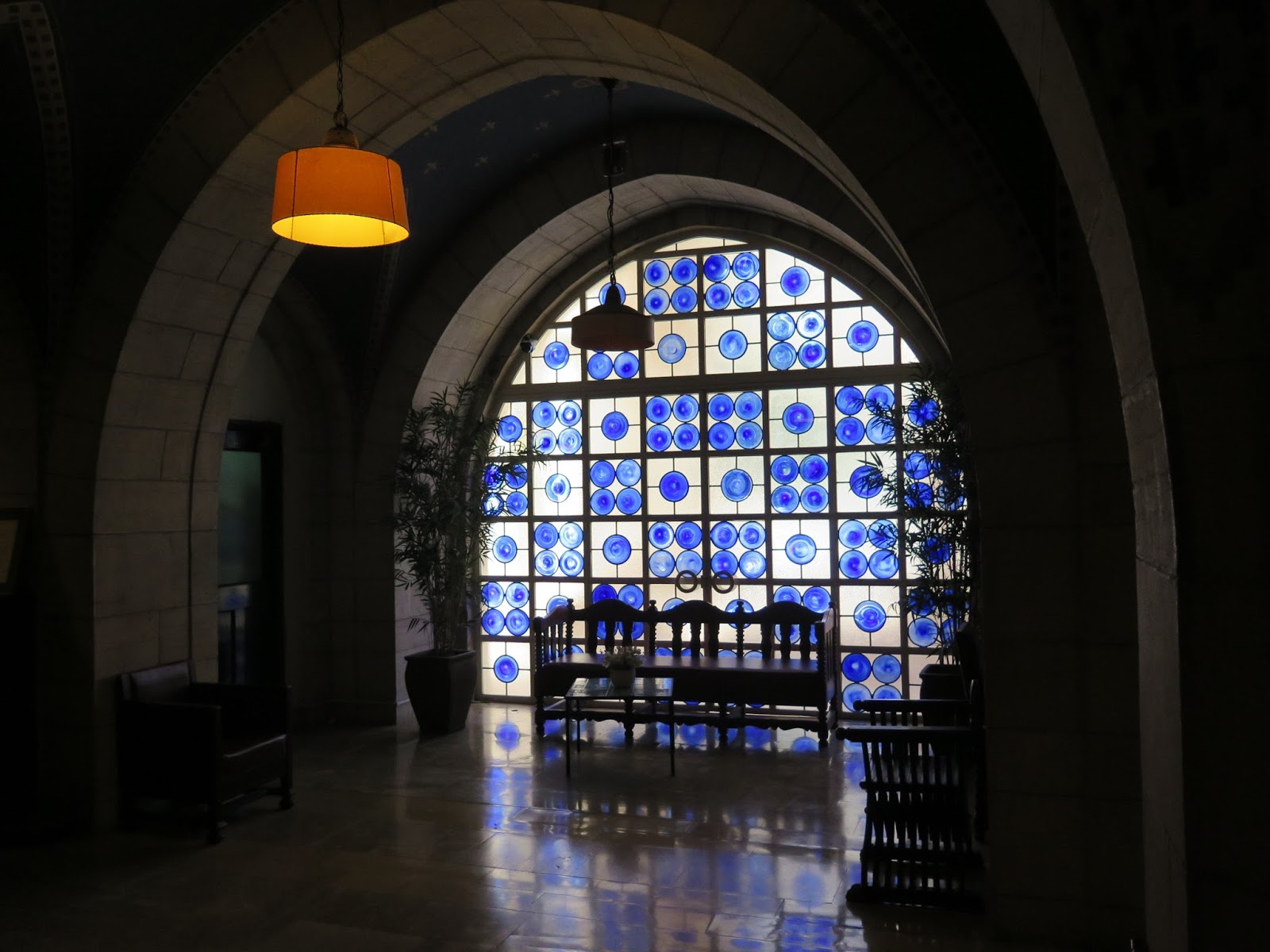
Each day we have spent with our family this past week has been wonderful, memorable and days we will always cherish. Everyone seems to be getting the jet lag under control so we are literally off and running every morning. Today we ventured first to Qumran, the location where the Dead Sea Scrolls were found. The first scrolls were found in 1946 and in the coming years until 1956, some 981 scrolls were found in 11 caves. Qumran has become a National Park and is one of the most interesting tourist attractions in Israel. Qumran is located on the Northwestern shore of the Dead Sea and had a Jewish population as far back as the 8th century BCE.

We saw a short film which explained that the Essenes (a break-away Jewish sect) once inhabited this area. They lived and studied here for two centuries and left in the surrounding caves a magnificent legacy that we now call the Dead Sea Scrolls.

In 1947, a Beduin shepherd found some ancient scrolls in one of the caves while searching for one of his sheep. Later some French archaeologists excavated the area and found additional scrolls. The scrolls, hidden in jars for nearly two thousand years were well preserved due to the arid climate. Included in these scrolls were books of the Old Testament, the Apocrypha and the sect's own works. Some of these works are on display at the Israel Museum in Jerusalem.

The Essenes paid great attention to ritual bathing (up to 10 times each day) and purity.

They lived a communal life in a settlement that made them self reliant. They had a very strict lifestyle. They had a central dining hall in which ceremonial meals were eaten. The Essenes scribes wrote most of the scrolls found in the adjoining caves.


We looked around, took lots of photos but this is the short version of the story of Qumran.

We had several other places to visit so we were off to the next adventure of the day.

G'pa Garth has been a great tour guide and he was excited to take us to En Gedi. This is the place where David hid from King Saul. Let's go back and review what happened here. When David killed Goliath, King Saul sought David to come and live at his house and the King Saul made David leader of his army. David married one of Saul's daughters but later Saul became jealous of David because the people loved David more than him. The King ordered his soldiers to kill him but David's wife warned him and let him escape and this was the area where he came and lived off the land.

Saul sent thousands of soldiers to find David and kill him. If you have water, you can survive just about anywhere and David lived here for a long time. However, one night David found King Saul crouching in a cave and rather than killing him, he cut off a piece of his skirt to show his loyalty.

This area is made up of soft limestone laid down over hard limestone. When rain falls, it sinks through the porous soft limestone until it hits the harder stone shelf and runs eastward into springs. Fresh water, ibex for meat and lots of caves for shelter were just what David and his men needed to survive many months in the wilderness.


The scriptures certainly come to life when
we visit the places where they happened.

We left Ein Gedi and headed to Masada.


There is a very steep path you can walk up to the top but we opted to take the tram.

When we reached the top, there was a walkway and
steps leading up to the top of the plateau.


"Claire, don't look down!"

"I've pictured this before but I am surprised to see what it really looks like."


King Herod had built an elaborate water system with aqua ducts that carried rain water and emptied into cisterns for storage.


Cistern used to store water.

It was amazing to think that nearly 1,000 people lived here at one time.
Below: The bath house was particularly interesting. These pillars
were underneath the floor.

The hot room floor has been partially reconstructed so that visitors can get an idea of what it would have looked like. These short clay pillars were beneath the bath floor which created an open space. A furnace would pump hot air into the space beneath the floor where it would circulate and create heat. The heat rising from the floor produced a Turkish-bath effect, like a sauna. In addition, the walls were lined with hollow clay pipes which were pumped full of hot air. When you exit the bath house you can see where the furnace would have stood to warm the waters and pump hot air through a hole in the bath house wall into the area beneath the bath house floor.

It was truly amazing to see some of the original frescoes which still remain on
some of the walls.


The black line shows the height of the original walls that remained
when the area was excavated.

The walk down to the lower castle was really steep! G'pa and G'ma decided not to walk down so there are no photos that show the really steep steps that lead down as you walk on the outer edge of the mountain.

The Roman camps can still be seen at the base of the plateau. (Rectangular area of rocks)
The photo below shows the ramp that the Roman
soldiers built to overtake Masada.
soldiers built to overtake Masada.


Masada was a very interesting place to visit!

We walked down from the top and got ready to take the tram to the bottom.
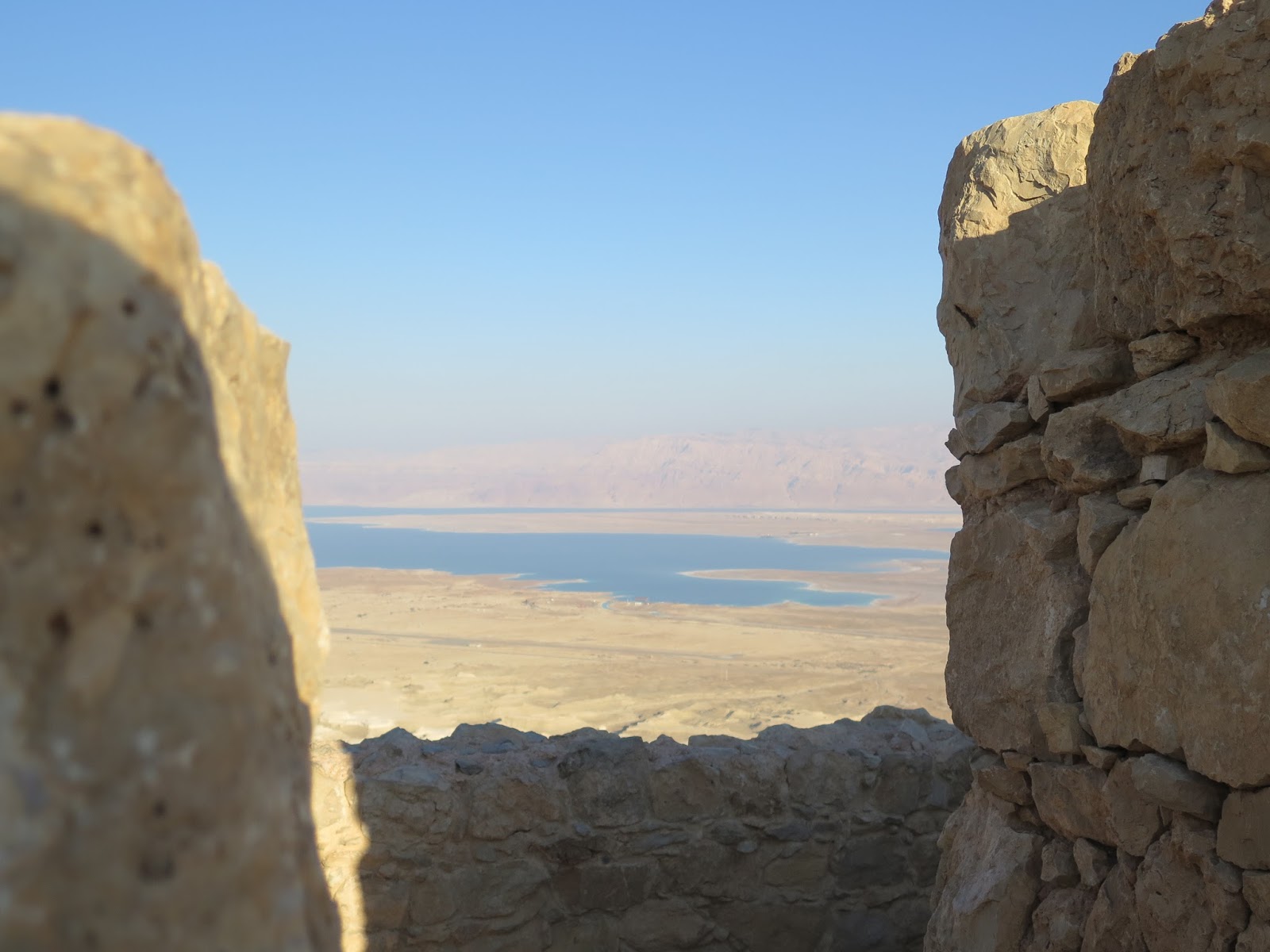
Our last stop for the day would be the Dead Sea seen in the distance.

We arrived at the Dead Sea about 4 PM so we had to hurry before the beach front closed.
We arrived at the Dead Sea about 4 PM so we had to hurry before the beach front closed.

Everyone was anxious to get in the water. G'ma Kathy watched.

Of course, G'pa Garth was the first to jump in.
He said, "Come on guys, this is fun!
Just put your shoulders under the water and you will float."
"Brr . . it's so cold!" said Claire.
"Oh, my gosh, the water is so cold and my whole body burns,"
said Hannah.

"This is awesome!"

G'pa said, "Just put your shoulders in and lean back."

Salt forms as crystals on the rocks along the shoreline.

We picked up some of the salt crystals and saved them to bring home.

The Dead Sea is almost 1,400 feet below sea level and the shores of the Dead Sea represents the lowest spot on earth.

"The water feels oily," said Adam.

"I'm getting out . . . I'm cold!"

Other than a few organisms, the Dead Sea contains no life!

"I'm freezing . . . let's go home!"

The end of another adventurous day in Israel.