There are some Jewish terms I will be referring to in this blog so get ready to learn about them:
TORAH, SOFER, MEZUZOT,
MEZUSAH and
TEFELLIN.
The day we visited Neot Kedumim it was very hot and therefore we didn't see all of the reserve. Jan Clayton, a previous organist at the Jerusalem Center, recently sent me a few photos taken in 2014 when they visited Neot Kedumim and I couldn't believe how beautiful it was. She said, "It was like a fairy land." I think we need to go back next year in the springtime and see it first-hand as the Claytons did.
Our guide took us to a shaded area to meet a Jewish scribe or
sofer. He has spent his entire life transcribing the
Torah and other religious writings.
The
Torah is Judaism's most important text. It contains the Five Books of Moses and is the source of the Ten Commandments and the 613
mitzvot. (The
mitzvot contains commandments or precepts in the Bible and additional ones of rabbinic origin.)
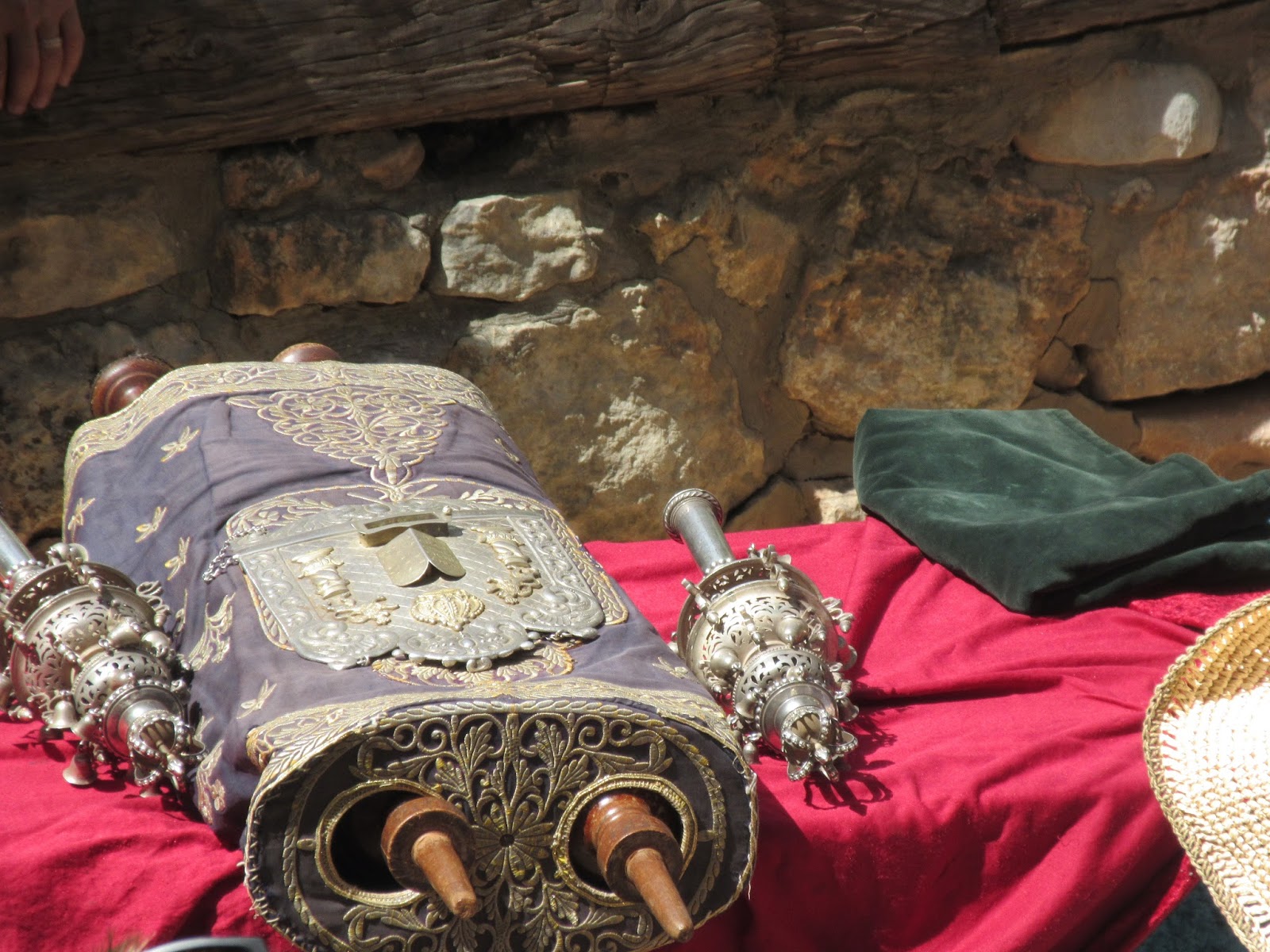
Photo: Torah
Photo: Sofer or scribe.
We asked the
sofer why he chose this vocation and he said he didn't. He explained that his father was a
sofer and this is a position traditionally passed down from father to son and he felt the responsibility to continue in his dad's shoes.
He apprencticed with his father and has spent his entire life studying and writing sacred documents. A
sofer is a copyist but the religious role in Judaism is much more because his functions as a calligrapher and writes documents such as marriage contracts, divorces and other religious texts.
There is a very strict process of copying religious texts by scribes and it takes years to learn.
Sofers can only use clean animal skins or parchment
mezuzots to write on or to to bind manuscripts.
If the
sofer makes a mistake, he has to start all over again and the manuscript cannot be thrown away but must be put in a cemetery where documents are buried.
Photo below: Torah
Our guide continued to explain that each column of writing could have no less than forty-eight and no more than sixty lines. The letters, words, and paragraphs have to be counted and the document becomes invalid if any two letters touch each other. The middle paragraph, word and letter must correspond to those of the original document. When finished, the documents can only be stored in sacred places such as synagogues.
The ink must be black and of a special recipe. The
sofer must wipe the pen and wash their bodies before writing the word “Jehovah,” every time they write it. The students were allowed to view the
Torah scroll and then it was rolled up and put in a special container to protect it. The sofer showed us the decorative parts of the case which holds the Torah and asked the professors to hold them.
The hardest part about learning to be a
sofer is not the calligraphy but remembering the thousands of laws that apply to the
Torah,
Tefillin,
Mezuzot and all the other texts that are written. I certainly had no idea what some of these terms were before we came to Israel. A
Mezuzot is a piece of parchment inscribed with specified Hebrew verses from the
Torah which is put into a decorative case.
Photo: Look closely. The guide is holding the
mezuzot and if don't look carefully, you won't see it because it blends in with the fence behind it.
This is a better photo of the
mezuzot our female guide was holding. (I discovered later there was a smudge on my camera lens so the photos are not the best.)
Photo: Decorative case which contains a mezuzot.
The guide explained that because the
Torah was received on Mount Sinai, Jews have been placing a
mezuzot in an ornamental casing (
mezuzah) of their doors. It's easy to confuse the two words since they are so similar but remember that one is parchment and the other is a case that holds the parchment.
The original source for placing a
mezuzah on the doors is in the Fifth Book of the
Torah.
In
Deuteronomy 6:9 as well as 1
1:20, the Jewish people are commanded,
"you shall write them on the doorposts of your house and upon your gates."
Jewish law states that mezuzahs must be placed on every door in a home or business owned by a Jew. Very specific instructions say that "it should be placed on the right side of the door from a place where everyone can see it when entering the building or room" and it supposed to be affixed to the "lower part of the upper third of the doorway, and should ideally be placed at a 45º angle, tilted towards the inside of the room."
The Next time we go into the Old City of Jerusalem, I will certainly be looking for
mezuzahs which identify Jewish merchants or residents. I have since learned there are a variety of styles
mezuzahs can be made: stone, wood, silver, brass, or even ceramic.
Next we learned about tefillin. Tefillin are a set of small black leather boxes containing scrolls of parchment (mezuzot) inscribed with verses from the Torah. They are worn by male Jews during weekday morning prayers. The guide showed us the tiny parchment that had been rolled up and put inside the tefillin and stretched it out so we could get a better look see how small the letters were.
Orthodox Jewish men wear tefillin under their hats. Exodus 13:9 says, "And it shall be for a sign for you upon your hand, and for a memorial between your eyes, that the law of the LORD may be in your mouth; for with a strong hand did the LORD bring you out of Egypt."
According to the Bible, Ezra recovered a copy of the
Torah (Genesis, Exodus, Leviticus, Numbers, and Deuteronomy) and read it aloud to the whole nation. From then on, the Jewish scribes (
sofers) solidified the process for creating copies of the Torah and eventually other books in the Old Testament. In 586 B.C., Jerusalem was captured by the Babylonians. The Temple was looted and then destroyed by fire and the Jews were exiled.
During the weekday morning service, one of the boxes (the "Hand Tefillin") is placed upon the left arm so that it rests against the heart and the suspended leather strap is wound around the left hand and around the middle finger of that hand.
The other box,
head tefillin, is placed upon the head and above the forehead so as to rest upon the cerebrum. After learning about the
tefillin, I had a much better understanding and was glad I could go back to photos I had taken at the Wailing Wall when we first arrived in Israel. A picture says a thousand words and I am grateful I can show you photos.
The duty of wearing tefillin rests upon males after the age of thirteen years and at the time of their Bar Mitzvah or their coming of age ceremony. Females are not required to wear them but can if they desire but not common. Others who are not obliged to wear tefillin include a mourner during the first day of his mourning and a bridegroom on his wedding-day.
Photo: Moses wearing a tefillin.
Originally
tefillin were worn all day but not during the night. Nowadays the custom is to wear them only during the weekday morning service, although we've been told that Orthodox Jews wear them during the day and as long as they are dressed in their "Orthodox attire" which includes a black hat, black suit, black overcoat, etc. As I thought about that, perhaps that might be another reason they wear a wide brimmed black hat in the effort to conceal or keep it covered. Afterall, tefillin is something sacred to Jewish men and I respect them for their dedicated efforts to live Judaism by the letter of the law.


Garth and I have learned so much over the past 5 months while living in Jerusalem and I sincerely hope you have learned a few things from us. We have come to understand the differences between ethnic groups. Each has their own set of values but each places an emphasis on modesty, respect for their elders, the home and the effort to make their dwellings a sanctuary or a little piece of heaven on earth. Some have so little it makes your heart break yet they try to live their lives in accordance to a Higher Power. I conclude this Sabbath day with a quote from Exodus 25:8 - "Make Me a sanctuary that I shall dwell among them."
 July the fourth is the day that congress accepted Jefferson's declaration but it was actually written on the 2nd of July.


 In honor of the Americans at the Jerusalem Center, our muslim chefs made a great effort to prepare a special American dinner with hot dogs, hamburgers, french fries, ice cream and watermelon slush! It has to be such a difficult task as chefs to prepare food for others while they are observing ramadam for 40 days. The last day of ramadan is Wednesday, July 6. We love and appreciate all the workers at the JC and they work hard to take care of all our needs.